Why the Strait of Hormuz won't reopen overnight
2 June 2026
The market is treating Hormuz as binary: open or closed. Energy Aspects' Maritime Analytics and proprietary geospatial intelligence show why the reality is more complex and why oil flow recovery will be slow, uneven and possibly incomplete.
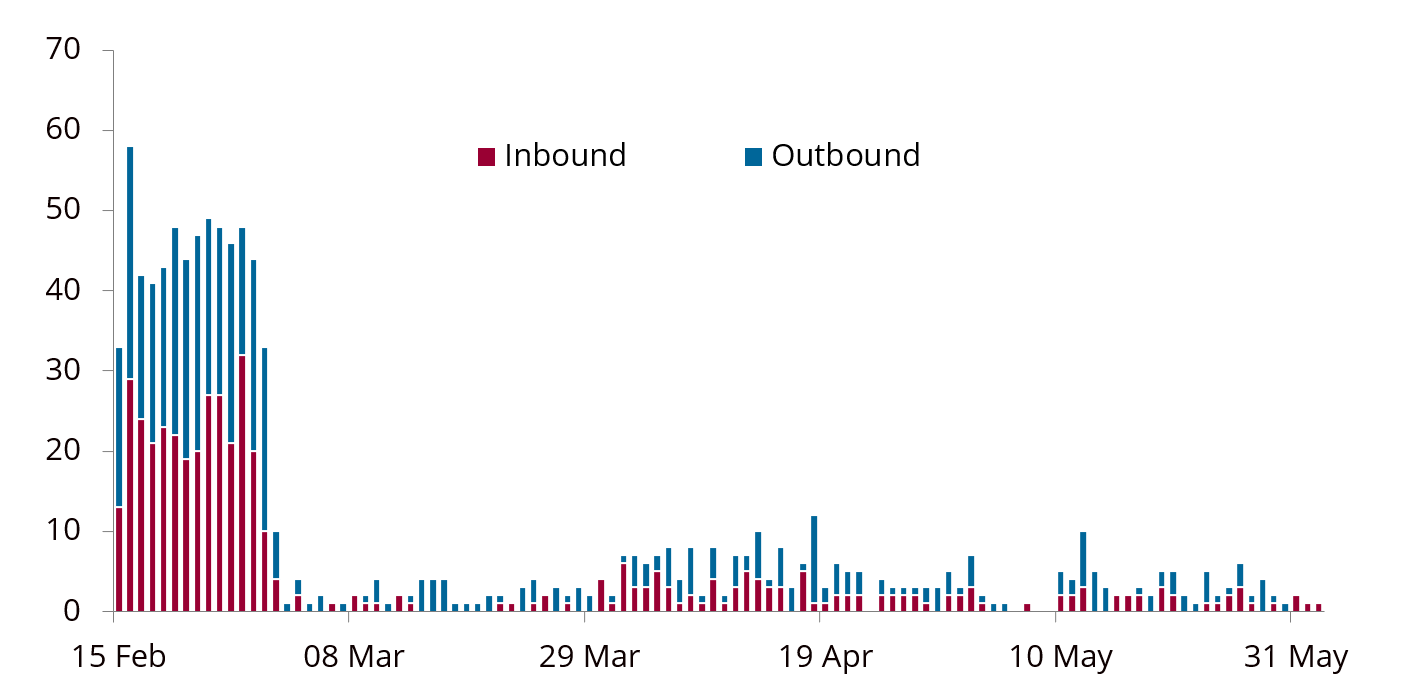
More than three months into the largest oil and LNG supply disruption in history, fewer than 50 laden non-Iranian tankers (excluding small tankers) have transited the Strait of Hormuz throughout May. While a number of individual transits have generated headlines suggesting a recovery in flows, the aggregate picture tells a different story.
EA Maritime Analytics data show outbound flows of non-Iranian oil have averaged 0.98 mb/d for crude, 0.22 mb/d of oil products (ex-methanol) and 0.10 mb/d for LPG in May, compared with pre-conflict flows of 17.8 mb/d. That is less than one-tenth of normal traffic. Isolated transits should not be confused with a meaningful recovery.
Hormuz oil tanker transits, #

Note: Basis AIS-derived data, including Iran-linked vessels, excl. small tankers
Source: Energy Aspects
What is actually crossing the strait?
Most vessels transiting Hormuz are using the northern shipping corridor close to the Iranian coastline, suggesting they have Iranian approval. Several Qatari LNG cargoes have crossed under a bilateral agreement between Pakistan and Iran. Crude oil shippers have been sending cargoes through with AIS transponders switched off, sometimes to carry out ship-to-ship operations in the Gulf of Oman.
Iran is approving only a limited number of vessels each day and is maintaining a sufficiently elevated threat level to deter most shippers from attempting to cross without permission. We estimate that 99 mb of crude, 37 mb of oil products and 279 kt of LPG remain stranded on tankers within Hormuz on board 247 vessels as of 2 June. Media coverage of individual transits can create the misleading impression that flows are normalising when the underlying data show otherwise.
Why a signed MoU would be just the beginning
The US and Iran are in the final stages of negotiating a memorandum of understanding. If agreed, it would commit both parties to gradually lift their respective blockades during an interim 30- to 60-day period. But as our geopolitical team has noted, nothing is agreed until everything is agreed, and wide gaps remain over Hormuz governance, Iran's nuclear programme and economic relief for Tehran.
Even under a signed MoU, confidence-building measures would include Iran allowing more tankers to cross and some easing of the US blockade, but this would fall well short of a full restoration of normal shipping flows. Mines would need to be cleared, an interim transit system established to sequence vessel crossings and shippers convinced the waterway is safe.
Our geopolitical analysis is embedded across all of our relevant energy market services.
Why shippers are unlikely to return quickly even after a deal
Most shipowners, refiners and traders view transit risks as too high, not only now but even in the early days after the strait reopens. The risk of sporadic attacks by Iran's proxies cannot be ruled out. Insurance premiums for Hormuz transits remain at levels that make many routes uneconomic. The central question is not whether isolated vessels can pass, but whether flows can resume at scale and with enough reliability to support genuine normalisation.
Several Gulf producers are developing or expanding pipeline routes that bypass Hormuz to reduce long-term exposure. This is a structural shift that will outlast the current conflict, underscoring that even market participants with direct stakes in Hormuz do not expect a return to pre-conflict normality.
What does EA's proprietary geospatial data show about inventory pressure?
The stranded volumes within Hormuz have prevented Gulf producers from restarting upstream production or refineries that depend on export flows via the strait. Kayrros satellite data show Iraqi onshore crude stocks have fallen by roughly 4 mb since mid-April as cargoes have been loaded from storage, but production is not yet being brought back online.
Meanwhile, the US blockade on Iranian exports has caused Iranian crude loadings to collapse to below 0.4 mb/d in May, from 1.8 mb/d in March. Crude tank utilisation at Kharg Island has risen to 84%, leaving only a few weeks before nationwide storage constraints begin to bite.
How should the market think about the recovery timeline?
We maintain our base case of oil transits reaching 50% of pre-war tonnage by end-June. Even this may prove optimistic. If disruptions extend into Q3 26, there are likely to be cascading supply shortfalls this summer, sharp price rises and medium-term impacts on global energy supply chains.
The largest disruption in oil and LNG market history is about to enter its fourth month. Government releases of strategic petroleum reserves have kept benchmark prices below demand-destruction levels for now, but the buffer is finite, the diplomatic path is uncertain and the operational challenges of restoring flows are substantial. A measured assessment of the recovery timeline requires looking beyond individual transits to the structural barriers that remain.

This analysis draws on Energy Aspects' proprietary maritime analytics, Kayrros geospatial intelligence and our geopolitical team's on-the-ground sources.
To explore how EA tracks Hormuz flows in near real-time and access the full depth of our crude, geopolitics and cross-commodity analysis, request a trial.
Maritime Analytics
EA Maritime Analytics delivers near real-time insights into global seaborne flows of crude oil, refined products and LNG — combining cargo tracking, flows nowcasting and freight market intelligence in a single platform.
Learn more
Kayrros geospatial intelligence
Satellite-verified energy intelligence for crude inventories, LNG outages and US E&P tracking with analyst-led insight. Measured data at terminal, facility and well level, independent of reported sources.
Learn more