How satellite data flagged Pluto LNG’s early start-up
July 31, 2026
Source: Eurostat, European Commission, Energy Aspects
When Woodside published its second-quarter 2026 report, it confirmed calls Energy Aspects had already made earlier: commissioning at the 5 Mtpa Pluto Train 2 LNG project is accelerating, with first LNG on track for Q4 26 (December 2026 in our forecast). We had been tracking the same milestones in near real time, using satellite thermal imagery and maritime data.
5
Mtpa Capacity
Pluto Train 2
Q4 2026
First LNG Forecast
December 2026
Pluto LNG is the anchor of Woodside’s Western Australian LNG portfolio, and Train 2 is the first new liquefaction capacity to come online alongside the broader Scarborough development. Its start-up date has moved through several rounds of revision as commissioning has progressed, making the sequence a useful test of how far operational data can substitute for waiting on scheduled disclosures.
How we track commissioning
Data Source 1
Satellite thermal imagery
Detects heat signatures from turbine start-up, flaring and process heating
Data Source 2
Maritime tracking
Real-time vessel positioning and loading analytics
Outcome
Facility-level insight
Rolling view of project commissioning sequence
We monitor LNG facility commissioning primarily through satellite thermal imagery, which picks up the heat signatures associated with turbine start-up, flaring and process heating well before a company confirms progress in a scheduled announcement.
Combined with maritime tracking of vessel positioning and loadings, this gives us a rolling, facility-level view of where a project sits in its commissioning sequence.
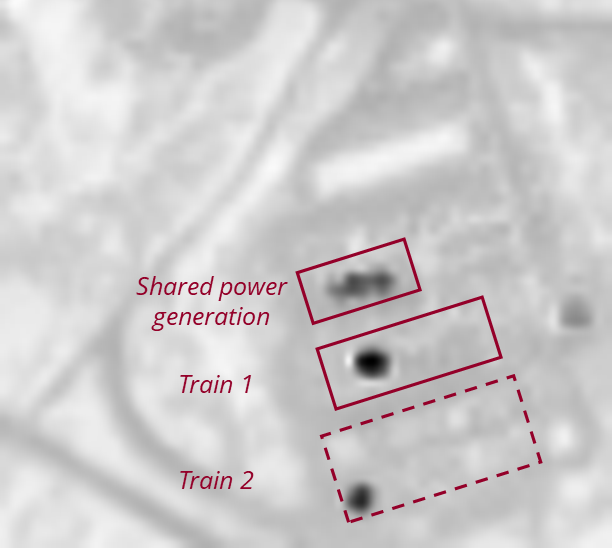
Energy Aspects thermal image of Pluto LNG

Source: ESA, Energy Aspects
Track global LNG supply disruptions, train-level activity and maintenance risk with near real-time alerts, historical data and forward-looking analysis
Source: Eurostat, European Commission, Energy Aspects
What we saw before the report landed
Our first signal came in late June, when thermal data picked up a clear heat signature on Pluto Train 2’s gas-fired power turbine, indicating early commissioning activity had begun. This followed a 28-day shutdown of Train 1 in May, during which the unit underwent compatibility upgrades to process Scarborough feedgas, the new supply source for the facility.
By mid-July, flaring intensity at the offshore floating production unit (FPU) had increased sharply, and we later detected a new heat signature at the onshore processing unit, consistent with gas being introduced for testing. Market soundings pointed to verification checks already underway on Train 2. Taken together, the power generation checks, the flaring, and the processing-unit activity told a consistent story of commissioning moving through its final stages.
| Month | Event | Overview |
|---|---|---|
| May 2026 | Train 1 compatibility upgrade | 28-day shutdown to process Scarborough feedgas |
| Late June 2026 | Heat signature detected on Train 2's power turbine | Early commissioning activity commenced |
| Mid-July 2026 | Flaring intensity increased at FPU | Gas testing & verification checks underway |
Source: Eurostat, European Commission, Energy Aspects
2.93
Germany
2.80
Netherlands
2.6
Belgium
2.5
Italy & Spain
Reading the signals against a known analogue
We used the roughly four-month interval between heavy flaring and first LNG exports at the Darwin LNG–Barossa project as a guide for timing Pluto Train 2’s own start-up. On that basis, we brought forward our first-LNG forecast for Train 2 to December 2026, from January 2027, adding 0.3 Mt of LNG supply to our winter 2026–27 balance and marginally reducing Asia’s call on Atlantic basin cargoes over the December–January peak heating period.
~4
Months Interval
Darwin LNG–Barossa project
December 2026
First LNG Forecast
Brought forward from January 2027
0.3 Mt
Supply Addition
Winter 2026–27 balance
What Woodside’s report confirmed
Woodside’s second-quarter 2026 report, published on 29 July 2026, corroborated each stage of the commissioning sequence we had tracked independently. The Scarborough Energy Project, including Pluto Train 2, was 98% complete at the end of the quarter (excluding Pluto Train 1 modifications), with all upstream infrastructure already in place. Subsequent to the reporting period, the FPU reached ready-for-start-up status and achieved first gas from the Scarborough reservoir, while the trunkline also reached ready-for-start-up status, allowing pressurisation from the FPU through to the onshore plant to begin. At the Train 2 site, the gas turbine generator completed synchronisation with the Pluto power grid, and mechanical runs were completed on three of the six liquefaction compressors. Woodside confirmed the first LNG cargo remains on track for Q4 26, consistent with our forecast.
“The successful completion of the Pluto planned maintenance during the quarter marked a key milestone in preparing for Pluto Train 2 integration and processing of Scarborough gas,” Woodside chief executive Liz Westcott said alongside the results.
Why the timing matters
A one-month shift in a single train’s start-up date changes the volume of Atlantic basin cargoes Asia needs during the December–January peak heating period, with a knock-on effect on the spread between the JKM and TTF benchmarks. Catching that shift as it happens, rather than waiting for the next quarterly update, is what our commissioning-tracking approach is built to do.
This case also illustrates why we treat commissioning tracking as a distinct discipline from steady-state supply monitoring. A project moving through start-up passes through several observable stages — power generation, flaring, compressor testing — before it loads its first cargo, and each stage carries information about how close the facility is to first exports. Reading those stages consistently, across many projects, is what let us move the Pluto Train 2 timeline a month earlier than our prior forecast with reasonable confidence.
The shift also feeds into a broader picture for Asian winter LNG demand. Northeast Asian buyers have already been contending with a slower-than-expected recovery in Middle East LNG export capacity this year, and any change to non-Middle Eastern supply, however small, affects how much of that gap the Atlantic basin needs to fill. Tracking Pluto Train 2’s commissioning closely therefore has a direct read-through to how tight the winter balance looks in practice.

LNG project timelines will keep shifting on short notice, and companies’ own disclosures often confirm progress only after the fact.
Our Global LNG service tracks commissioning, loadings and outages in near real time using satellite imagery, maritime data and ground-level sourcing across the world’s LNG portfolio. To see these signals as they develop, request a trial of our LNG intelligence service here.