


Low stocks, slowing SPR releases and China's return put a floor under crude

August 13, 2026


Source: Eurostat, European Commission, Energy Aspects

The crude market has spent months trading headlines. Peace headlines trigger aggressive selling, while supply disruptions of comparable significance draw a far more muted response. Despite nearly five months of disruptions to Strait of Hormuz transits and the prospect of lasting losses to supply capacity, crude has not sustained a geopolitical risk premium. Dec-27 copper has risen by as much as Dec-27 WTI since the start of March. 

But even if Oman and Iran reach a deal that lifts transit volumes, and the US makes parallel concessions including lifting the naval blockade and restoring sanctions waivers, crude should not return to the lows of June. At Energy Aspects, we see three reasons why. 

Global crude stocks are far below pre-conflict levels 

3

mb/d Draw

Global inventory draw in July

400

mb Below

Crude stocks vs. pre-conflict levels

70

mb Decline

Oil-on-water drawdown

Kayrros Crude Oil Inventories shows global inventories drew by 3 mb/d in July, driven by a 70 mb decline in oil-on-water, leaving crude stocks around 400 mb below pre-conflict levels–one of the largest crude inventory draws on record. 


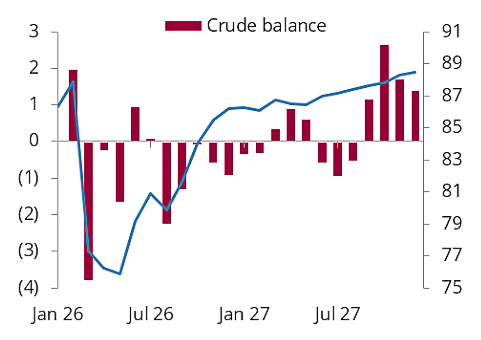
The market that priced June's lows was working with more slack. Stocks were higher and far more barrels sat stranded inside Hormuz. Refining margins are extremely strong, diminishing the market’s ability to balance through run cuts.

Global crude balance vs supply, mb/d 

Global crude balance vs supply, mb/d

Source: Energy Aspects 

Source: Eurostat, European Commission, Energy Aspects

SPR releases have more than halved from their peak 

The latest weekly US Strategic Petroleum Reserve release rate dropped to just over 0.4 mb/d, with the average since July slowing to 0.52 mb/d, more than halving from the peak. Outright SPR levels have fallen below 300 mb. The release has also shaped how the market trades the disruption, structured in a way that requires significant hedging. 

China has gone from balancing the market to potentially tightening it 

China did the heavy lifting to balance the crude market by slashing imports through the spring. That reduction was widely read as evidence of permanent demand destruction. We disagreed. It reflected a halt to strategic stockpiling and lower refinery runs, the latter underpinned by petrochemical destocking and a near-halt to product exports. 

13.8

mb/d Runs Forecast

August 2026; raised by 0.5 mb/d

3.6

Mt Product Exports

Clean product exports planned in August

8.4

mb/d Imports

July crude imports; upside surprise

>9

mb/d Nowcast

August crude imports EA Nowcast

Those conditions are now unwinding. Inventories across the Chinese polyolefin chain are tight and the pace of drawdown is no longer sustainable, so runs have been rising since July. Beijing then unexpectedly relaxed August product export controls, and we raised our August runs forecast by 0.5 mb/d to 13.8 mb/d, with refiners planning up to 3.6 Mt of clean product exports for the month.


July crude imports surprised to the upside at 8.4 mb/d and our August Nowcast is above 9 mb/d. Prompt Dubai backwardation is holding at around $9/bbl despite the peace headlines. Having balanced this market by slashing imports, China could now tighten it on its own. 

The market is selling regardless 

None of this has stopped the selling. Positioning is skewed towards fading geopolitical risk, and algorithmic traders in particular are geared towards selling given the skew of headlines since the US–Iran war began. The US administration has a clear bias towards lower oil prices and has gone to considerable lengths to hold them down, through public messaging and temporary sanctions waivers. Some Middle Eastern producers have also overstated how quickly production has recovered, discounting barrels and feeding fears of oversupply.


Bearish 2027 balances are the other constraint, with macro investors focused on reinitiating short positions on expectations of a glut and the UAE's departure from OPEC read as a step towards materially higher output next year. If generalists expect prices to fall to $40–50/bbl, anchoring the back of the curve, there is only so far the front can rise. 


The floor under crude now depends on how quickly Chinese buying builds and how much further stocks can fall.


Our crude oil coverage combines global inventory data with refinery run and import forecasting across every major region.

Recent Posts

Yen and Yang: Treasury Finds Rare Victory in Japan FX Gambit
August 12, 2026
Oil, gas ¯ro market insights: Hormuz deal nears, Qatar LNG risks EU winter supply, Fed hike expected ¥n intervention marks rare Treasury win.
Kayrros LNG intelligence
July 31, 2026
Our thermal imagery flagged Pluto Train 2’s faster commissioning weeks before Woodside’s Q2 26 report confirmed the same milestones.
EU electrification plan won't lift power demand yet
July 27, 2026
Why the EU's Electrification Action Plan is unlikely to accelerate European power-load growth before 2030, according to our Europe Power forecasts.
Show More