


PJM sets the tone for tighter summer, while ERCOT’s longer stack suppresses forwards
June 19, 2026
Heading into summer, the two largest
US power markets are diverging: PJM is tightening in the near term, while ERCOT remains loose, even as large load additions arrive across both. In PJM, strong load growth across the Dominion and AEP footprints is the driving force. Our summer balances are unchanged month on month, but cash realisations have rallied on the back of early heat. In ERCOT, weather-normalised load growth leaves the fossil call higher than last year, even as significant battery and solar additions lengthen the stack.
Key Figures
Sitting over PJM is RGGI, with Virginia's accession on 1 July looming despite prices falling after the June auction. Our latest North America power outlook sets out what these dynamics mean for spark spreads this summer.
| Market | Near-Term Direction | Driver |
|---|---|---|
| PJM | Tightening | Strong load growth (AEP 1.25 GW, Dominion 0.9 GW y/y) and early heat. |
| ERCOT | Loose | ~7 GW each battery and solar additions, ~1 GW gas, lengthening the stack. |
PJM: load growth, heat drive cash realisations
The PJM narrative has shifted. Earlier in the year, transmission and generation outages drove cash prices; now load growth and weather are doing the work. We continue to see strong load growth in the PJM footprint, with AEP at 1.25 GW and Dominion at 0.9 GW year on year as of April, and our summer balances are unchanged month on month.
That demand strength is showing up in cash. A summer peak load record in Dominion lifted day-ahead on-peak congestion sharply, with Dominion congestion expected to support West Hub realisations through the peak summer. We lowered our NQ-26 spark forecast to $57.17/MWh on falling RGGI and gas prices, leaving us well below the market spark but still close to $10/MWh above last year's realisation.
ERCOT: longer stack, offsets higher call on fossil
ERCOT has a longer supply stack heading into summer, with roughly seven GW each of battery and solar capacity additions and about one GW of gas capacity by the end of the month.
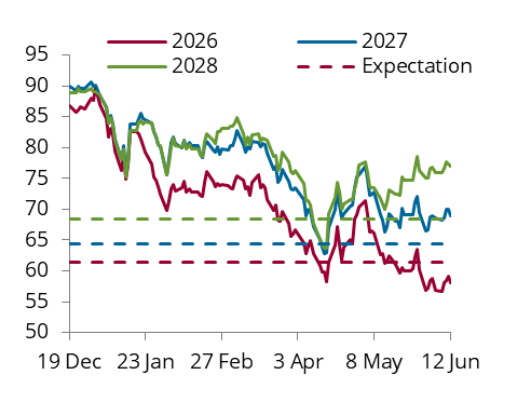
Weather-normalised load growth of about 3.3 GW pushes the fossil call higher, leaving ERCOT nominally tighter year on year. But those supply additions have pushed forward sparks to our fair value forecast, reflecting a much looser market y/y.
One point worth flagging for clients reading the official data: ERCOT's August MORA showed a 10.2 GW year-on-year rise in peak-risk-hour demand, but we think this overstates large loads’ ability to energise ahead of the summer.
ERCOT-N NQ on-peak spark spreads $/MWh

Note: Spark is at 7 heat rate and off HSC gas
Source: ICE, Energy Aspects
RGGI: prices ease as the programme signals more supply
RGGI is the carbon overlay shaping fossil generation economics in PJM and the Northeast. Prices dropped after the 3 June auction cleared at $35/st, below the prevailing ICE level. The programme has not stood still: RGGI, Inc. followed up on its threat to add more supply by announcing the start of scoping to bring prices into line.
The tax-credit backdrop
There is a policy story running alongside the market one. A 4 July construction deadline for Safe Harbor renewable tax credits has driven a rush among solar developers, while a Department of Defense permitting freeze has stalled the wind pipeline. This will support solar capacity additions in the near term, while posing long-term downside risk for wind development.
Why this matters
For power market participants, the read into summer now diverges: PJM is tightening on strong load growth and limited new supply, with RGGI's supply path and Virginia's 1 July accession adding a moving part, while ERCOT stays loose as battery and solar additions outpace demand. Getting these dynamics right is central to positioning for the season.
This analysis draws on Energy Aspects’ Live Broadcast: 'North America gas and power outlook’ recorded 16 June 2026, featuring Mike Lawn (Global Head of Power), David Seduski (Head of North American Gas) and Brian Myers (Head of North America Power).
Energy Aspects' North American Power service tracks load growth, supply additions, pricing changes and policy across PJM, ERCOT and every major US power market.