

EU ETS Reform 2026: What the new LRF really means for carbon costs
July 23, 2026
The Commission's proposal: Opening bid, not final word
On Friday, 17 July, the European Commission released its long-anticipated EU ETS review proposal. The Commission's proposal for EU ETS reform will represent the least bearish iteration of the policy changes, but we expect it to be watered down through the European Parliament and Council's during EU’s legislative process.
The shift towards prioritising competitiveness in both institutions, driven by post-2024 election dynamics and broader concerns over industrial resilience, will ensure market balances after the final reform emerge significantly softer than the Commission's initial starting point.
Why the soft LRF matters more than headlines suggest
The Linear Reduction Factor (LRF)—the annual rate at which the total emissions cap shrinks—is one of the key headlines in the proposal. The proposed 3.7% LRF for 2031–35 and 1.7% LRF from 2036–40 mean balances are moderately tighter for the first half of the next decade, but there are more volumes left at the back end. The ETS cap only goes to zero in 2046 with these parameters.
A key change to Energy Aspects' base case is the adoption of the proposed post-2030 linear reduction factor, which adds back around 275 Mt to total supply over 2031–40 compared to our previous 3.4% LRF.
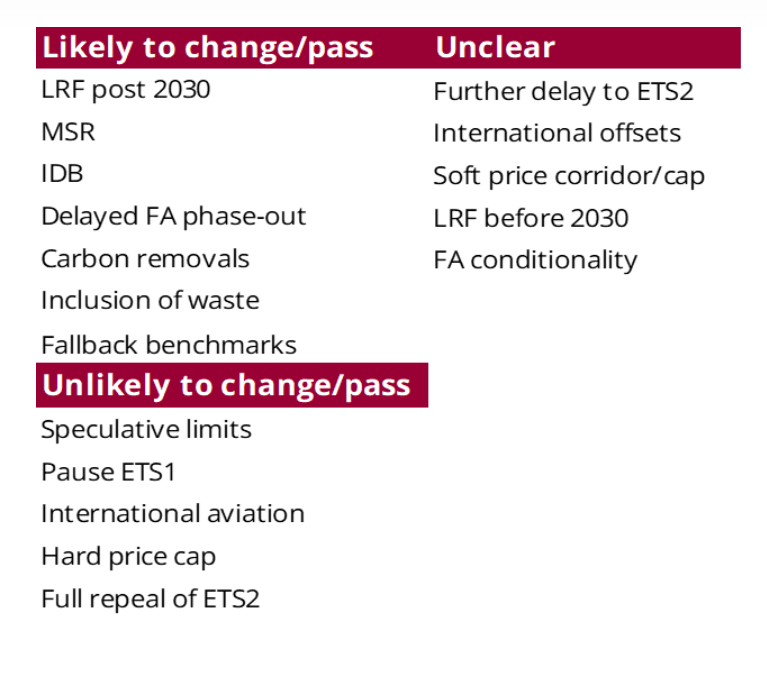
EA views on ETS elements
Source: Energy Aspects
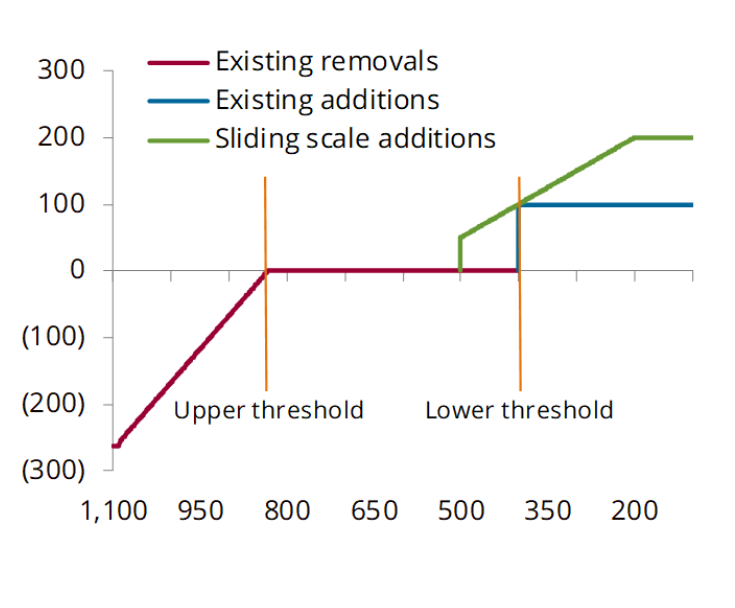
MSR removals and additions, Mt
Source: European Commission, Energy Aspects
Carbon price implications
Our revised carbon price forecast of €124/t for 2031–35 (down from €136/t) largely reflects the MSR adding in volumes faster than under previous rules. For 2027–30, we now average €95/t compared to our previous base case of €97/t.
But the political reality matters more than headlines. There are 10 central and southern member states (a blocking minority) pushing for an even greater softening of the LRF to only have the EU ETS cap go to zero in 2050. The Commission's proposal is genuinely the ceiling for ambition—not the floor.
€95/t
2027–30 Average
Down from €97/t prior forecast
€124/t
2031–35 Average
Down from €136/t; MSR-driven decline
Free allocation: The hidden industrial win
Whilst the LRF grabbed headlines, free allocation—how companies receive allowances without paying for them—represents the real cost story for industry. The proposals leave it at 15% until 2038. We expect these could be further weakened through the legislative process.
A delayed phaseout of free allocation is likely to happen, as this has broad support across both the Parliament and Council as a means of easing the industrial cost burden.
However, there's a significant conditionality attached. Companies must prove they are executing energy efficiency audits and formal "Climate Transition Plans" to receive free allocations and will need to undertake actual green investment to receive all of their free allocation. This represents a substantial shift—free allocation is now conditional on demonstrated decarbonisation commitment.
MSR reforms: Supply injection dynamics
The Market Stability Reserve (MSR) is the EU ETS's shock absorber. The MSR proposals make it more likely to add supply back to auctions earlier than under previous balances. The most important change is the total number of allowances in circulation, the key parameter deteriming how the MSR works, is to be considerably lowered. This will mean the MSR starts adding back allowances far faster. The removal of the invalidation factor will also mean the MSR can put back more allowances into auctions over a longer timeframe, helping further loosen the market. Somewhat countering that loosening is the proposal to annually decrease the upper and lower thresholds. A 4% decrease starting in 2028 would mean the 2035 upper threshold is 566 Mt and lower threshold is 272 Mt, with a lower buffer of 300 Mt.
MSR reform appears certain, with appetite to overhaul how the mechanism absorbs surplus allowances and adds volume back to auctions growing.
566 Mt
2035 Upper Threshold
4% annual decrease from 2028
272 Mt
2035 Lower Threshold
Lower buffer: 300 Mt
Innovation booster and the Innovation Decarbonisation Bank (IDB) - impacts on supply
The market was anticipating the investment booster and IDB proposals, and the proposals showed that some 400 Mt of EUAs could be reserved for helping finance investment for industrial decarbonisation projects being developed out to 2030. Another 400 Mt of EUAs would be also available in 2031-2040.
While that is considerable volume, the proposed rules suggest very little of those EUA will be available to the market by the end of 2030 and not all of them by 2040. Still, we think these proposals should help stimulate some decarbonisation investment in the EU.
International offsets and carbon removals
The proposal allows up to 2% of the cap to be used for eligible international offsets in 2036–40. The further addition of carbon removals credits is supposed to come in from 2031. The proposals are to increase the cap by 250 Mt and use revenue from that to have the Commission purchase carbon removals.
Carbon removal costs are well above what the EU price is now, and removals still aren't really affordable. Only around 10 Mt of real additional subsidy is likely in 2031–35. The real opportunity lies in electrification and grid infrastructure, supported by robust governance integrating planning, financing, cooperation, and progress monitoring.
For policy stakeholders, this represents a pragmatic balance: domestic abatement is eased via offsets, whilst the EU retains credibility on climate targets.
The political road ahead: Why this proposal will only soften further
The European Commission's proposal for EU ETS reform will represent the least bearish iteration of the policy changes, but we expect it to be watered down through the European Parliament and Council's legislative process.
The reform will adjust and recalibrate the existing framework—softening the LRF, overhauling the MSR, delaying free allocation phaseout and folding in removals and the waste sector—rather than fundamentally reshaping it.
The European Parliament's and Council’s renewed focus on competitiveness following the 2024 elections is reshaping the trajectory of EU ETS reform. We expect the legislatures versions of the proposals will aim to soften the proposal further.
Key political risks to monitor
| Element | Status |
|---|---|
| The LRF | There are 10 central and southern member states pushing for an even greater softening to have the EU ETS cap go to zero in 2050. |
| Aviation scope | While softer than leaked, we still think that very few member states will support this proposal. |
| Likely to pass | Softer LRF, MSR overhaul and delayed free allocation phaseout likely to get both Parliament and Council support. The inclusion of carbon removals and the waste sector are both less controversial and will also likely be passed. |
The bottom line: Expect further softening
Energy Aspects' key takeaway: The Commission has offered some modest weakening of the legislation so that climate policy is broadly retained while accommodating concerns over industrial competitiveness. We have largely adopted the European Commission proposals as our new base case, with a few exceptions, even though we recognise there will be plenty of further changes along the legislative path.
The more radical measures such as a pause to ETS1 and hard price cap unlikely to survive.
This is the start of a long legislative road. Market participants should position for the Commission's proposal to soften further—not tighten.
EU ETS review: Breaking down the headlines
Date: 21 July 2026
Duration: ~52 minutes
Speakers: Jahn Ivar Olsen
(Head of Environmental Products), Trevor Sikorski (Head of Natural Gas and Emissions)
Description: Energy Aspects hosted a live broadcast on 21 July 2026, breaking down the Commission's proposals in real-time detail with analysis of price forecasts, political positioning, and actionable insights for policy analysts, traders, and renewable energy investors.
Watch the webinar on-demand
Recent Posts