

Henry Hub is waiting on new LNG terminals
June 19, 2026
Our bal-summer
Henry Hub forecast sits above the forward curve, but the bigger call is on the ceiling: with little new LNG capacity due online before H2 27, sustained prices above $3.50/MMBtu outside winter are unlikely. Strong production growth and a comfortable storage carryout reinforce a market that stays well supplied through 2027.
Key Figures
The call
Our view, set out in the North America gas outlook, frames the price ceiling around LNG timing. Our bal-summer Henry Hub forecast is above the forward curve, but we align with the market on the lack of sustained prices above $3.50/MMBtu until new LNG terminals come online.
EA Price Ceiling — Outside Winter Months
$3.50
/MMBtuThe ceiling matters more than the small premium to the curve. Outside the winter months, the market lacks the demand pull to push prices materially higher until new export capacity arrives.
The rationale: production outruns demand
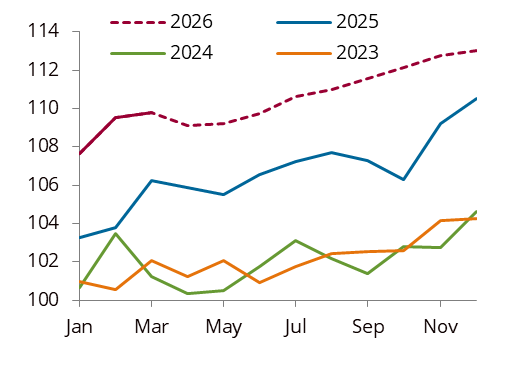
The balance is tilted towards oversupply, and production is the reason. We expect production flows to recover from maintenance in June, rising by 0.5 bcf/d month on month. We still expect Lower 48 output to near 113 bcf/d by year-end on Permian gains.
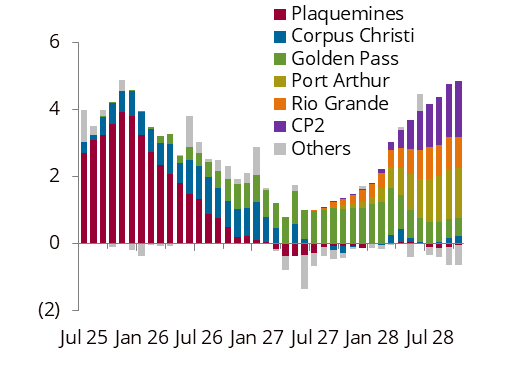
On the demand side, LNG is the swing factor, and the timing works against any near-term tightening. The contribution of new LNG terminals will do little to tighten 2027 balances.
However, we expect LNG feedgas demand to grow by 3.6 bcf/d y/y in 2028. In the meantime, seasonal May and early-June maintenance has cut into US feedgas demand as expected, and Golden Pass's slow commissioning has limited upside as well.
Lower 48 gas production, bcf/d

Source: EIA, Novi Labs, Inc., Energy Aspects
The outcome: storage stays above average
US LNG feedgas demand by terminal y/y, bcf/d

Source: DOE, Ventyx, Energy Aspects
The supply-demand picture feeds straight into inventories. We forecast a 3.91 tcf end-October 2026 storage carryout, and production growth will keep inventories above average into H2 27. That comfortable carryout is exactly what caps the price ceiling outside the winter peaks. "Henry Hub is waiting on new LNG terminals for support."
The principal counter-balance to persistent oversupply would come from producers rather than buyers. A sustained tightening would more likely come through production discipline than a sudden surge in demand.
Why this matters
For traders and hedgers, the call reframes where the risk sits. The near-term debate over a few cents around the curve is secondary to the structural reality that the next leg of LNG-driven demand does not arrive in force until H2 2027. Until then, production growth and a healthy storage position keep a firm lid on summer prices, with producer discipline the main mechanism for any tightening.
EA's unique value
This call combines basin-level production modelling with terminal-by-terminal LNG feedgas tracking and a weekly storage trajectory, giving clients a single, forward-looking view of where balances and prices are heading rather than a reaction to the latest print.
This analysis draws on Energy Aspects’ Live Broadcast: 'North America gas and power outlook’ recorded 16 June 2026, featuring Mike Lawn (Global Head of Power), David Seduski (Head of North American Gas) and Brian Myers (Head of North America Power).
Energy Aspects' North American Gas service tracks Lower 48 production, LNG feedgas demand and storage trajectories against the Henry Hub forward curve.