


JKM–TTF front-month spread rises: Energy Aspects’ bullish call validated

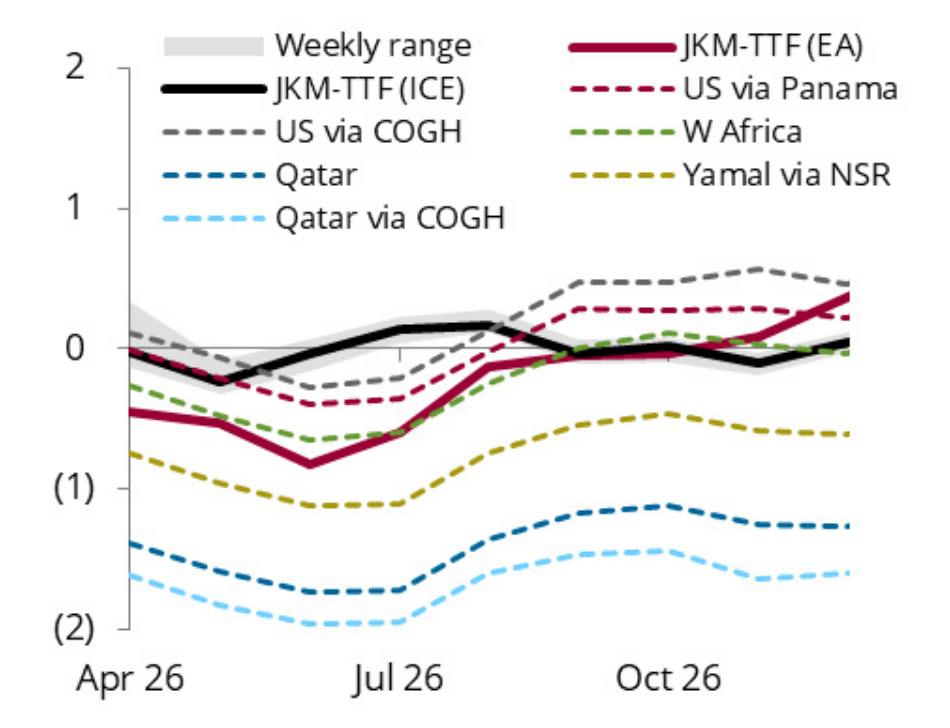
In early 2026, the global LNG market was closely watching the JKM–TTF front-month spread, which had been averaging around Qatari shipping differentials. At this level, all flexible Atlantic and Middle Eastern cargoes would be incentivised to head to Europe rather than Asia. Many market participants expected the spread to remain subdued, but Energy Aspects identified several factors pointing to a likely increase. 

The call: EA Live Market Update – February 2026 

Throughout the start of 2026, Energy Aspects maintained a bullish stance on the JKM–TTF front-month spread, consistently highlighting that the spread needed to rise from Qatari to West African shipping differentials. Our analysis emphasised that, with reduced nuclear availability in South Korea, Asia continues to rely on Middle Eastern and some flexible West African cargoes to balance. As we stated: "We still think the JKM–TTF front-month spread needs to rise to prevent Middle Eastern or even Pacific cargoes from being diverted to Europe".

JKM–TTF spreads, LNG freight differentials, $/MMBtu  

JKM–TTF spreads, LNG freight differentials, $/MMBtu

Source: CME, Fearnleys, Argus Media Group, Energy Aspects

Proprietary analysis and real-time monitoring 

Our view was grounded in our underlying supply and demand analysis. Even as our Pacific balance tightened the previous week and loosened this week, we maintained that the market front-month was still priced too low. We regularly update our balances, and while we recently revised Chinese LNG demand down by 0.8 Mt, our bullish call on the JKM–TTF front-month spread was not driven by week-to-week balance changes. Instead, our view remains that the market front-month was still underpriced, given broader structural factors such as ongoing nuclear maintenance in South Korea and Asia’s continued reliance on Middle Eastern and some flexible West African cargoes to balance. Additionally, proprietary cargo tracking showed a lower-than-average share of West African and US LNG heading east of Suez, supporting our view that the spread would need to widen to attract more flexible cargoes. Our analysis of shipping differentials and freight costs reinforced this perspective.

Market moves in line with EA’s forecast 

Recently, the JKM–TTF front-month spread rose above our forecast, validating our bullish call. The increase reflected the need for Asia to maintain its imports from the Middle East and attract some flexible West African cargoes, just as we had anticipated. Our clients were able to position ahead of the move, benefiting from timely, actionable intelligence.

Why this matters

For LNG traders, portfolio managers, and market analysts, anticipating shifts in regional price spreads is critical for optimising cargo flows and managing risk. Energy Aspects’ real-time, data-driven analysis provided a clear signal before the market reacted, helping clients capture value and stay ahead of shifting trade dynamics.

EA’s unique value

Energy Aspects’ Global LNG service delivers timely, actionable insight powered by proprietary analytics, near real-time cargo tracking, and deep market expertise. Our ability to cut through market noise and anticipate key price moves reinforces our reputation as a trusted partner in LNG market intelligence. 

Stay ahead with Energy Aspects 

For a deeper dive into our global LNG analysis, request a trial or subscribe to our research services.


This insight was originally published for EA Clients on 17 February 2026.

Recent Posts

Emission
June 3, 2026
The EU-UK summit, reportedly in July could confirm ETS linkage, narrowing the EUA-UKA spread and reshaping European carbon markets for years to come.
Why the Strait of Hormuz won't reopen overnight
June 2, 2026
The market is treating Hormuz as binary: open or closed. EA's proprietary maritime data shows oil flow recovery will be slow, uneven and may never fully normalise.
High-frequency data show limited demand response to oil prices
May 28, 2026
High-frequency data suggest higher oil prices have yet to trigger meaningful demand destruction, with trucking, gasoline and jet fuel consumption largely resilient.
Show More