What EU-UK ETS linkage means for carbon prices
2 June 2026
The EU-UK summit, reportedly scheduled for 13 July, is expected to confirm a formal link between the two emissions trading systems. This would be the most significant structural change to European carbon markets since the UK left the EU ETS in 2021.
European carbon markets are pricing in a landmark shift. The EUA-UKA spread had narrowed to below €13/t, its lowest since the start of February, as the market anticipates a linkage announcement at the EU-UK summit. UKA prices surged close to 6% on 26 May alone, compared with a 1% rise in EUAs. The question is no longer whether linkage will happen, but how quickly it will reshape the price landscape.
EUA-UKA Spread
€13 /t
Lowest level since start of Feb, as market prices in EU-UK linkage
UKA Performance (26 May)
~6%
Surged 6x EUA's 1% daily rise ahead of EU-UK summit
What would ETS linkage actually mean?
Linking the EU and UK emissions trading systems would make allowances issued under either scheme mutually recognised for compliance in both. Regulated entities could trade across jurisdictions, creating a larger, more liquid carbon market. The agreement is also expected to establish the conditions for mutual exemptions from the respective Carbon Border Adjustment Mechanisms, removing what would otherwise be a significant cost for UK exporters to the EU.
The UK government has highlighted that linkage would prevent British firms from paying an estimated £800 million to the EU's carbon border tax. For the EU, the deal deepens economic integration with a major trading partner and expands the carbon market's reach. The European Partnership Bill, which the UK government announced in May, would align UK legislation with EU single market rules in relevant sectors, reducing one of the key risks around dynamic alignment.
How will the EUA-UKA spread evolve?
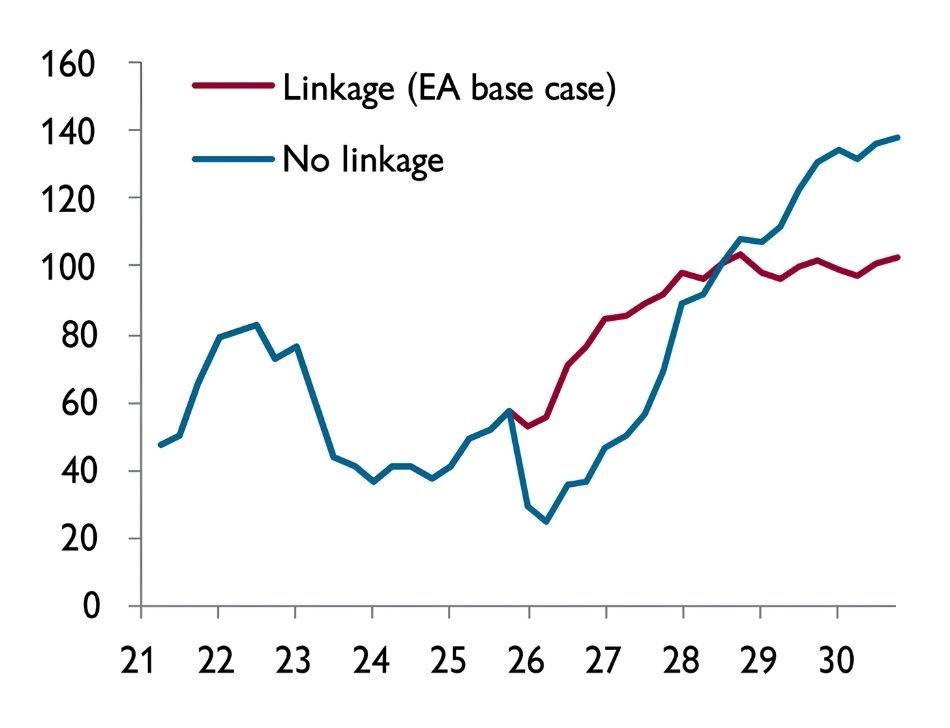
Energy Aspects expects the EUA-UKA spread to fall below €10/t by end-2026, with a gradual convergence over 2027-28 as lawmakers on both sides ratify the deal and update their respective laws. Full price alignment is expected from 2029 as linkage takes effect operationally. EA estimates that 90% of the linkage will be priced in upon successful conclusion of negotiations.
On the UKA side, EA forecasts prices to average £74/t in H2 2026, supported by the linkage announcement. EUAs are expected to remain rangebound around €75-80/t in the near term, with policy reform uncertainty limiting directional moves until the European Commission publishes its EU ETS proposals in July.
UKA price forecast with and without linkage, £/t

Source: Energy Aspects
What are the risks to the linkage timeline?
The most prominent near-term risk is UK domestic politics. Uncertainty around Keir Starmer's tenure as prime minister has weighed on UKA prices in recent months. Energy Aspects had lowered its Q2 2026 UKA price forecast by £1/t on this political risk. A leadership challenge could delay the summit, though our view is that even a change of Labour leader would not derail linkage, given broad cross-party support for closer EU integration.
If the summit is pushed back to end-2026, we forecast UKA prices to average £57/t in H2 2026, versus £71/t in the base case. A complete breakdown in talks, which we consider unlikely, would see UKA prices fall to around £32/t by year-end. Linkage negotiations are part of a broader package that includes agreements on food standards and a youth mobility scheme, adding complexity to the timeline.
How does EU ETS reform change the picture?
The European Commission is due to publish EU ETS reform proposals in July, coinciding with the summit. Our post-reform risk case lowers the average EUA price over 2026-30 by €7/t, reflecting plausible rule changes including adjustments to the Market Stability Reserve, slower CBAM phase-in and the frontloading of Industrial Decarbonisation Bank financing. The reform process adds almost 400 Mt of supply over 2026-30 in the risk case.
For carbon market participants, the interaction between linkage and reform is critical. If EU ETS reforms loosen balances more than expected, the convergence target for UKA prices shifts lower. Conversely, if reforms are modest, the combined market would be tighter, supporting prices across both systems. The sequencing of reform proposals and linkage confirmation in July makes the month a pivotal one for European carbon pricing.
What does this mean for UK emitters and compliance buyers?
UK ETS fundamentals will have a limited role on prices as long as linkage remains the key pricing nexus. UK verified emissions came in at 80 Mt in 2025, down 6 Mt year on year, with industrial closures in steel, refining and chemicals driving the decline. The scrapping of the UK Carbon Price Support from April 2028 will moderately raise UKA demand in winter hours, but EA does not expect this to materially change the price outlook under a linkage scenario.
For compliance buyers, the practical implication is that hedging strategies should increasingly reference EUA price levels rather than treating the UK ETS as an isolated market. The transition period between announcement and full implementation will create opportunities for spread trading, but the direction of convergence is clear.

This analysis draws on Energy Aspects' Emissions service, including our EU and UK carbon price forecasts, ETS balance modelling and policy analysis. To access the full depth of our emissions coverage, request a trial.
Europe Carbon Emissions
Energy Aspects' Europe Carbon Emissions trading service offers comprehensive tracking of supply, demand, and price trends, along with their interaction with policy updates for carbon trading schemes across Europe.
Learn more
North America Carbon Emissions
Energy Aspects' North America Carbon Emissions service meticulously tracks supply, demand, and price trends, along with their interaction with policy updates for carbon trading schemes across the continent (including both the USA and Canada).
Learn more