


Hard reboot: Democratic wave threatens AI boom

November 10, 2026


The Democrats' overwhelming victory has triggered a sharp selloff in technology stocks, as investors fear that growing political opposition to data centres could derail the AI investment boom underpinning US economic growth.


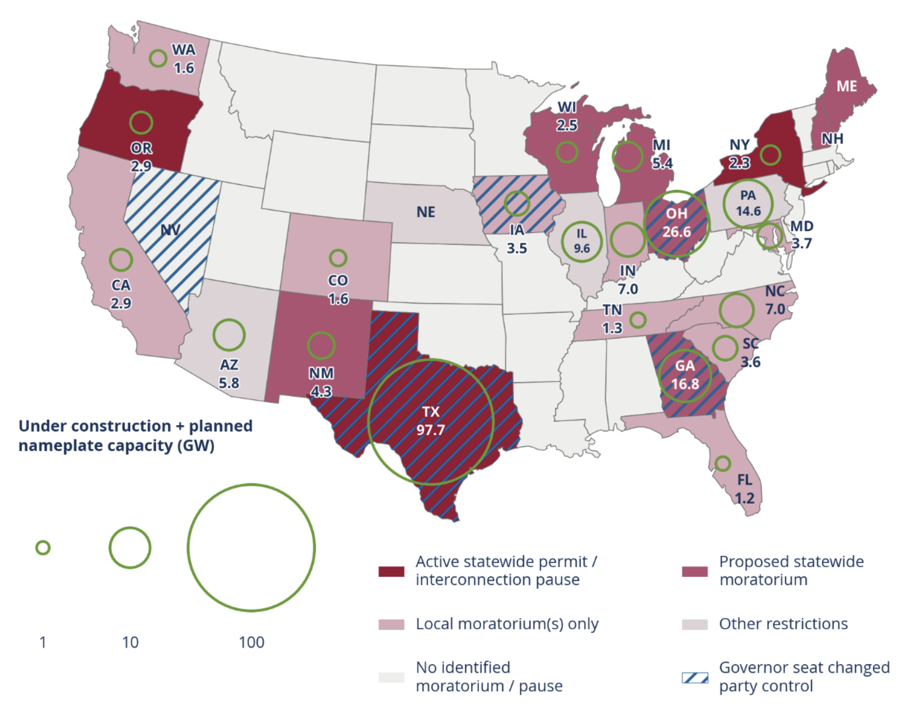
Democratic victories in key data centre states, including Texas, Ohio and Georgia, have raised the prospect of construction moratoriums and tighter permitting restrictions, threatening electricity demand growth and exposing stretched AI valuations.


The implications extend well beyond Silicon Valley. Those three states account for 141 GW of planned and under-construction data centre capacity, including 97.7 GW in Texas alone. Governor-elect Gina Hinojosa's proposed moratorium could extend existing restrictions, while similar measures in Ohio and Georgia threaten further delays to projects and grid connections.


Political opposition is becoming another constraint on US power demand growth, alongside transmission bottlenecks and lengthy grid connection queues.

US data centre moratorium landscape 

Venezuelan crude production, mb/d

Note: Capacity data through 2030; excludes projects without CODs in Baxtel Source: Baxtel, US DC Map, Energy Aspects

Oil

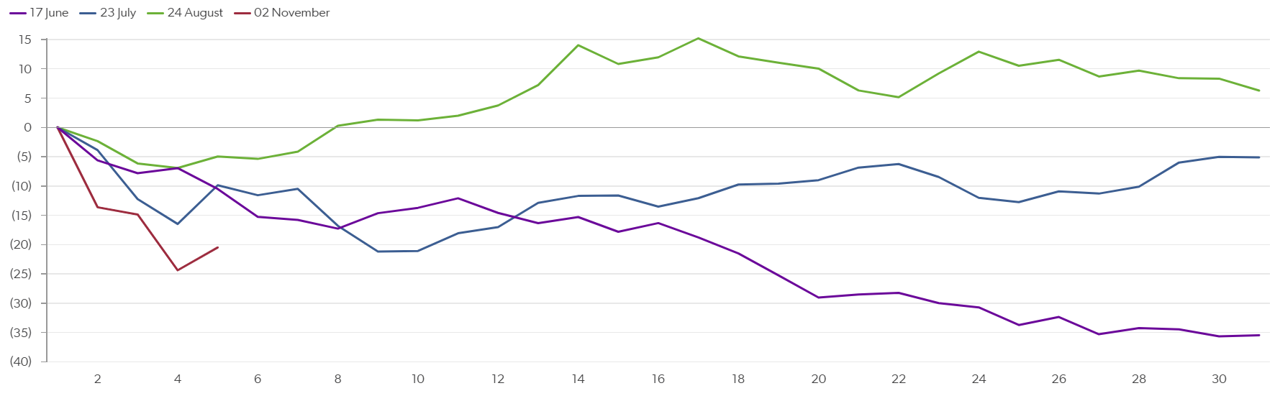
Crude has surrendered its October rally as fading expectations of renewed US–Iran strikes have erased much of the geopolitical risk premium. However, we believe escalation risks remain underpriced.


Physical balances are loosening. Global crude inventories rose by 42 mb in October, while Saudi Arabia and the UAE restored pre-war output, accelerating shipments and building precautionary stocks against the threat of renewed escalation.


Diesel markets remain considerably tighter. US inventories have fallen below 100 mb for the first time since 2003, while European markets remain firm despite rising Asian supply. Further Middle Eastern disruptions could tighten product markets even as crude inventories rebuild.

Brent headline-driven pullbacks, % change from peak

Weekly average satellite-derived crude vessel loadings in Strait of Hormuz, count/day

Source: Energy Aspects 

Recent TTF declines mask persistent tightness in European gas fundamentals. Colder weather and weak wind generation have accelerated storage withdrawals, with our forecast end-March inventories at just 21%, heightening deliverability risks.


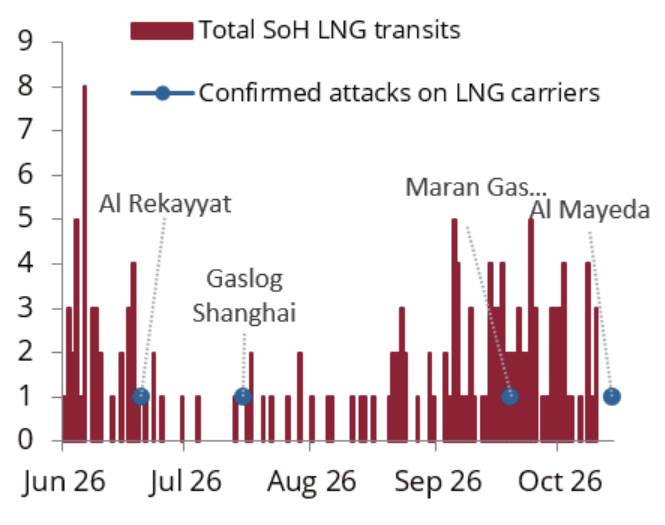
Qatari LNG disruptions add to the pressure, as we expect exports to halve from October's 2.5 Mt by year-end. Limited fuel-switching capacity and pipeline supply upside leave Europe competing with Asia for Atlantic basin LNG cargoes.


US gas faces contrasting pressures. Mild weather is suppressing demand, while new Permian pipelines support production growth. A sustained warm winter could force production shut-ins next spring.

Daily LNG transits via the Strait of Hormuz

TTF vs coal–gas fuel-switch triggers, €/MWh

Source: Energy Aspects

Democratic control of Congress offers limited restraint on US president Donald Trump's military options, while intensified diplomacy has failed to narrow fundamental US–Iran disagreements.


Tehran demands an end to the blockade, sanctions relief and the unfreezing of assets before reopening the Strait of Hormuz, while Washington insists on meaningful nuclear concessions. Neither side appears willing to compromise.


Trump may allow more time for negotiations, but additional US naval deployments will expand his military options later this month. We still see renewed strikes as more likely than not if diplomacy fails, with Iranian retaliation against regional energy infrastructure risking a wider conflict.

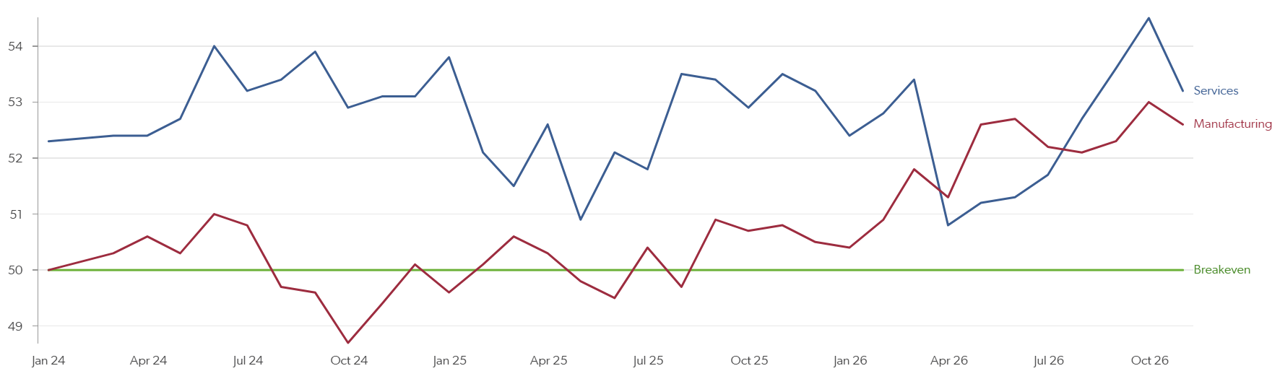
The AI selloff risks obscuring resilient economic fundamentals. Global manufacturing surveys still point to moderate growth, while US payrolls rose by 165,000 in October and unemployment fell to 4.1%. Markets appear to be pricing a sharper economic slowdown than the data justify.

Global PMIs, diffusion indices

Global manufacturing PMIs, diffusion indices

Source: JPMorgan, Energy Aspects

The real danger is that the selloff becomes self-fulfilling. Falling technology valuations could widen credit spreads, choke off financing and force AI suppliers to cut investment. Renewed Middle East escalation would amplify the damage by pushing up inflation and limiting the Fed's ability to cushion the downturn.

Positioning

Crude's selloff has reset positioning. Negative gamma amplified the decline as dealers sold into falling prices, while Brent's retreat into the high $90s/bbl pushed CTAs towards flat. Risks are more balanced, although volatility could constrain systematic trading.


The TTF faces upside squeeze risks, with dealer hedging cushioning declines towards €80/MWh but potentially amplifying rallies towards €105/MWh.


Technology positioning may limit further downside, as hedge funds and retail investors have already reduced exposure, lowering forced-selling risks.

This article was first published on LinkedIn. For a deeper dive into this topic and to stay updated with our latest insights, you can access the full newsletter here.

Recent Posts

November 11, 2026
What the report covers: Corn’s release-day move averages 1.46 times the sessions around WASDE since 2010, with soybeans, Chicago wheat and Kansas wheat close behind, all significant at the 1% level. Soy products, sugar and livestock show no reliable WASDE effect and sit within the range random non-release days produce. In corn and soybeans, volatility continues into the session after the release, while wheat reprices faster.  Discretionary positioning is most stretched in sugar and livestock, where WASDE matters least. That leaves soybeans and Kansas wheat as the most exposed markets into the release. Grains are the only ags markets where WASDE has historically justified pricing an event premium into options.

November 9, 2026
Kayrros US Data Centre Monitoring, delivered with Energy Aspects, found that data centres have become the swing factor in US power demand, and markets are already
October 14, 2026
Oil markets face substantial upside risks as Iranian tanker attacks intensify, Houthi strikes threaten Saudi energy infrastructure and global crude inventories
Show More