
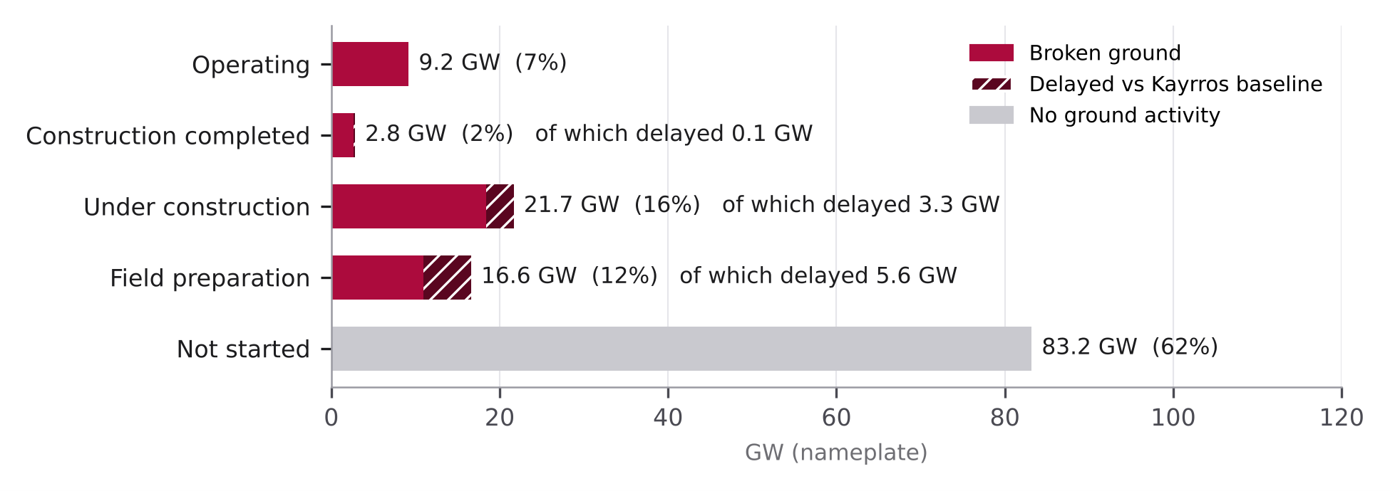
- Of the 129.6 GW of planned capacity we track, 88.3 GW (68%) shows no ground activity.
- 3.1 GW is expected to reach full capacity in the next six months, and our median prediction is 11.8 GW in the next twelve months.
- 9.2 GW across 109 buildings runs behind our forecast baseline: 22% of the capacity under way. 50 of 112 active campuses have at least one delayed building.
- A Texas permit freeze, federal interconnection reform and tighter capital now sit between announcement and energisation, while 12.0 GW of on-site behind the meter generation allows developers to bypass interconnection queues, but not supply chain backlogs.
Load forecasts that price concrete not headlines
Data centres have become the swing factor in US power demand, and markets are already paying for it. Our power research team expects US48 weather-normalised load to increase by 14% from 2026 to the end of the decade, driven predominantly by data-centre demand. PJM's latest capacity auction cleared at its price cap and still fell 6.8 GW short of its reliability target. In ERCOT, requests to connect large loads have reached nearly 500 GW.
Most of that load exists only on paper. Developers announce campuses in gigawatts, file for interconnection and publish target dates that rarely survive permitting, financing and power supply. Two-thirds of the planned capacity we track shows no ground activity. In ERCOT we observe only 5.8 GW of capacity under active construction or in the commissioning phase. Where work has started, more than a fifth of the capacity is running late. Across the US we expect 12.9 GW of new capacity in the next 12 months. Assumptions based on the queue are a forecast of hollow announcements.
Our answer is the ground truth. Kayrros US Data Centre Monitoring, delivered with Energy Aspects, follows US campuses above 50 MW expected online in the next 12 to 48 months from satellite imagery, building by building. It shows what is built, what is late, and what is still on paper, and dates when each building reaches full capacity, independent of developer announcements. Coverage stands at 163 campuses and grows with every release.
Four headwinds hit an already inflated pipeline
Four forces now widen the gap between what is announced and what gets energised.
- Backlash has reached the ballot box. Voters in 38 local jurisdictions are weighing at least 41 measures that would delay, prohibit or add conditions to data centres, 21 of them in Ohio (Reuters, 29 Oct). In Sunbury, Ohio, a 25 MW cap could derail a $2bn Amazon development.
- Regulators are following. On 3 Aug, Abbott ordered an audit of every data centre in ERCOT's queue, and ERCOT delayed its Batch Zero study. On 21 Sep he told TCEQ to issue no data-centre permits until the audit is done which could be in December but likely slides into 2027. At the federal level, FERC issued show-cause orders to six RTOs and ISOs on 18 Jun covering large-load studies, cost allocation, co-location and behind-the-meter generation.
- Capital is tightening. Hyperscalers are expected to invest about $800bn this year and more than $1tn next year (Fortune, 2 Nov). OpenAI cut its latest funding target to $20bn from $30bn, per the FT, and a recent Meta filing cites an "increasingly challenging environment for raising capital". Projects that need fresh money for each phase slow first.
- Power is the binding constraint. Energy is the Achilles heel of AI. Developers that cannot wait for interconnection build their own supply. Our release tracks 12.0 GW of on-site generation at 11 campuses.
What US Data Centre Monitoring measures
Each building moves through field preparation, construction, ramp-up and operation. Optical imagery measures footprint and progress, and footprint times power density gives capacity. Thermal imagery confirms when a building starts drawing power. Each building carries a lower-bound and a median forecast, refreshed every two weeks.
1. Ahead of the curve: capital buys parallel construction
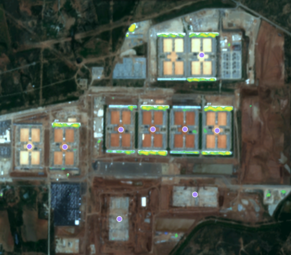
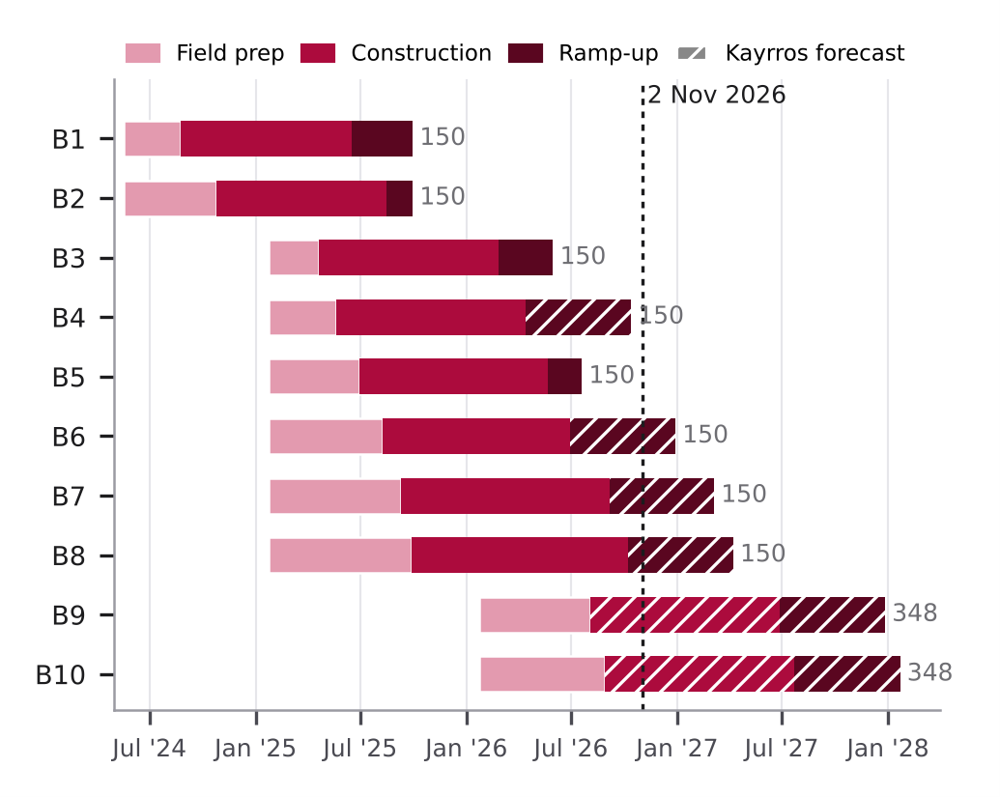
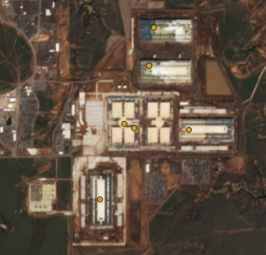
Stargate Abilene, built by Crusoe for Oracle and OpenAI, took 25 months from the first construction start to the completion of buildings 1 to 8 (1.2 GW). Each building took 326 days on average to construct, which is only three days more than what we observed on average across 157 completed buildings. Buildings 3 to 8 (900 MW) all entered construction between April and September 2025.
ERCOT substation data show the campus drawing nearly 0.7 GW through September, against 1.2 GW of expected utility load for buildings 1 to 8 (Energy Aspects, 23 Oct). Thermal imagery confirmed buildings 3 and 5 in operation. On site, 360 MW of gas turbines run under a TCEQ standard permit. A major permit for about 1.4 GW more, to power buildings 9 and 10, has been pending since November 2025.
2. Behind the curve: same developer, slower clock
Crusoe is also developing Google's campus at Goodnight in Armstrong County, Texas, and says it is building "at the same swift pace we set in Abilene" (Crusoe, 28 Sep). Our data show a slower clock. Buildings 1 and 2 (300 MW) entered construction in September and October 2025 and are now flagged delayed. Our updated expectations are that building 1 and 2 enter full capacity in November 2027 and January 2028, against a developer date of 30 Jun 2027. Six buildings, 780 MW in total, are under construction, with 933 MW of associated on-site generation.
3. Announced at gigawatt scale, little or no data-centre construction
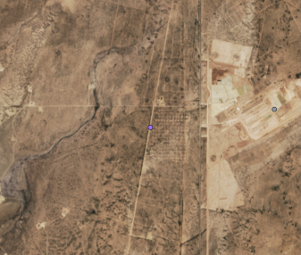
GW Ranch in Pecos County, Texas, belongs to Amazon, which confirmed ownership in August and filed state permits for three buildings of about 200,000 sq ft each (ENR, 11 Aug). The campus is announced at 5 GW, with about 6.75 GW of planned on-site generation. Field preparation began on 7 Jul 2026 and covers more than 7 million sq ft, yet no vertical construction is visible. We expect the first 100 MW at full capacity in February 2028, against the developer’s announcement of June 2027.
Fermi America's Project Matador near Amarillo has announced 11 GW, powered by gas turbines and nuclear. Our imagery shows no data-centre construction and some activity where gas generation is expected. We have flagged this lack of activity to clients since earlyJuly, 2026. The CEO and CFO left in April with no tenant signed (E&E News, 20 Apr). A 222 MW, $6.5bn lease with TensorWave followed in August, but its closing was pushed to 31 Oct pending an investment-grade guaranty (Fermi, 22 Sep). Closing had not been publicly confirmed by 2 Nov.
How clients use the data
- Congestion and FTR desks map campuses to nodes and time local load ramps building by building.
- Fundamentals and forward-curve teams at utilities, IPPs, funds and developers replace announced pipelines with satellite-dated ramps, using the P50 and lower-bound dates as a range.
- Equity analysts test delivery claims from hyperscalers, neoclouds and converted miners ahead of earnings.
- Gas and midstream teams size on-site gas generation campus by campus to determine gas burn.
- Systematic funds backtest on point-in-time release history, with forecasts shown next to actual operating dates.
The questions we hear most. Is it running? We confirm operation by thermal signal, a credible announcement or elapsed time after construction. How accurate are the forecasts? Subscribers get the full release history to backtest. How much reaches the grid? Capacity is nameplate, with on-site generation reported beside it, so users apply their own load factor.
Get ahead of the 2027 ramp
Coverage grows with every release, by 20 campuses at a time, toward every US campus above 50 MW in the US. Early adopters can choose which sites we add next and shape the roadmap and what features get prioritized next. Data arrives every other Thursday through the Energy Aspects portal, with imagery for each building, data downloads and an API.
Announcements slip. Satellites don't. Contact your Energy Aspects account manager for a data sample or a trial.
Coverage at a glance
552 buildings, 133.4 GW across 25 states and 8 grid regions
Median forecast. Lower bound: 29.7 GW
106 buildings at 49 campuses
11 campuses, reported beside load, never netted
Kayrros US Data Centre Monitoring, release of 2 Nov 2026. Nameplate capacity. Next 12 months: 3 Nov 2026 to 2 Nov 2027.
Source: Kayrros, Energy Aspects. Contains modified Copernicus Sentinel data 2026.
Appendix: methodology and references
Methodology
- Capacity is nameplate data-centre load, estimated from measured building footprint and power density by facility type. It is not metered demand.
- Full-capacity dates are Kayrros P50 (median) forecasts of the end of ramp-up, not first energisation. The lower bound is the earliest plausible full-capacity date.
- Delayed means a building is running behind the Kayrros forecast baseline.
- Operation is confirmed by thermal signal, a credible public announcement after construction ends, or elapsed time after construction.
- On-site generation is campus-level nameplate, counted once per campus, reported beside load and never netted.
- Planned capacity excludes buildings already operating (124.2 GW of 138.8 GW tracked).
- Parallelism cohort: 38 campuses with at least four tracked buildings. Fleet construction median: 157 buildings with an observed construction end.
Kayrros and Energy Aspects sources
- 1. Kayrros US Data Centre Monitoring, Full Release_2026-11-02. All Kayrros figures in the article, the Fig 1 chart, the Fig 2 timeline and the dashboard.
- 2. Energy Aspects, "ERCOT permit data thin the data centre queue, but advanced projects drive 2027-28 ramp", North America Power, 23 Oct 2026. Stargate Abilene consumption, interconnection rights and ERCOT audit timing. https://my.energyaspects.com/research/north-america-power/reports/north-america-power-insight/2026-10-23-ercot-permit-data-thin-the-data-centre-queue-but-advanced-projects-drive-2027-28-ramp__blta0da42bd9b677db3
- 3. Chart and dashboard data: DCM_article_chart_data_2026-11-02.xlsx (sheets README, Fig1_status, Fig2_Stargate_Gantt, Key_stats, Parallelism_cohort, Example_sites).
External sources
- 4. US Department of Energy, "DOE releases new report evaluating increase in electricity demand from data centers", 20 Dec 2024. https://www.energy.gov/articles/doe-releases-new-report-evaluating-increase-electricity-demand-data-centers
- 5. PJM Inside Lines, "PJM capacity auction procures 138,318 MW of generation resources...", 2028/29 Base Residual Auction, 14 Jul 2026. https://insidelines.pjm.com/pjm-capacity-auction-procures-138318-mw-of-generation-resources-as-work-continues-to-address-growing-electricity-demand/
- 6. Utility Dive, "Facing an estimated 474 GW of interconnection requests, Texas hits pause on data centers", Aug 2026. https://www.utilitydive.com/news/texas-hits-pause-data-center-interconnections/827046/
- 7. Office of the Texas Governor, "Governor Abbott directs TCEQ to halt data center permits", 21 Sep 2026. https://gov.texas.gov/news/post/governor-abbott-directs-tceq-to-halt-data-center-permits
- 8. Utility Dive, "6 takeaways from FERC's data center interconnection decision", Jun 2026. https://www.utilitydive.com/news/ferc-doe-data-center-interconnection/823360/
- 9. Reuters, "AI data center boom faces backlash at US ballot box", 29 Oct 2026 (via Investing.com). https://investing.com/news/stock-market-news/ai-data-center-boom-faces-backlash-at-us-ballot-box-4982297
- 10. Fortune, "The AI boom is facing another supply crunch. This time it's the amount of capital available", 2 Nov 2026 (cites Financial Times and Wall Street Journal). https://fortune.com/2026/11/02/ai-boom-supply-crunch-capital-debt-bonds-capex-spending/
- 11. Associated Press, "OpenAI gets $110 billion in funding from a trio of tech powerhouses, led by Amazon", Feb 2026. https://www.standard-journal.com/ap/business/article_567c48d5-d7f4-5ea0-b80b-08d9fb029d51.html
- 12. Texas Commission on Environmental Quality, Standard Permit Registration 177263 technical review, Longhorn Data Center, Abilene, Jan 2025. https://records.tceq.texas.gov/cs/idcplg?IdcService=TCEQ_EXTERNAL_SEARCH_GET_FILE&dID=8600163&Rendition=Web
- 13. Texas Commission on Environmental Quality, notice for Air Quality Permit 182126, PSDTX1688 and GHGPSDTX263, Longhorn Data Center Buildings 9 and 10, Nov 2025. https://www.tceq.texas.gov/downloads/permitting/air/bilingual/pending-permit-notices/182126-nori-english.pdf
- 14. Crusoe, "Crusoe developing data center campus in Armstrong County, Texas", 28 Sep 2026. https://crusoe.ai/resources/newsroom/crusoe-developing-data-center-campus-in-armstrong-county-texas
- 15. ENR, "Amazon discloses ownership of GW Ranch, giant Texas data center-gas power complex", 11 Aug 2026. https://www.enr.com/articles/63464-amazon-discloses-ownership-of-gw-ranch-giant-texas-data-center-gas-power-complex
- 16. E&E News by Politico, "CEO's exit casts doubt on massive Texas data center plan", 20 Apr 2026. https://www.eenews.net/articles/ceos-exit-casts-doubt-on-massive-texas-data-center-plan/
- 17. Fermi, "Fermi and TensorWave agree to extend closing date to October 31, 2026", 22 Sep 2026. https://www.newswire.com/news/fermi-and-tensorwave-agree-to-extend-closing-date-to-october-31-2026