


European jet tightness was an early Energy Aspects call
April 23, 2026
When conflict in the Middle East began disrupting oil flows through the Strait of Hormuz in early March, Energy Aspects quickly identified a key risk for oil products markets: European jet fuel was set to tighten sharply as Middle East flows dried up and replacement barrels proved limited.
That view has since played out. European jet fuel imports have fallen sharply in April, ARA stocks have been drawing, and the market has remained firm as supply options narrowed.
Europe’s jet fuel exposure was clear from the start
Europe is particularly vulnerable to disruption in Middle East jet fuel flows. A significant share of its imports normally comes directly from the region, while alternative supply options are limited when Asian balances are also tightening.
Our early March analysis showed this was not simply a case of delayed oil cargoes. Refinery run cuts in the Middle East and Asia were creating a more persistent supply loss, while freight constraints, export restrictions and regional competition for barrels were making replacement supply harder to secure.
Oil cargoes already on the water helped keep Europe supplied through March, but that cushion was always temporary. Once those barrels were absorbed, the balance was set to tighten.
The call in real time: How Energy Aspects tracked the tightening jet fuel market
- 6 March 2026: An EA Live post warned that jet fuel would remain relatively stronger than diesel because resupply options were more limited. We highlighted Europe’s dependence on Middle Eastern jet fuel imports and said the region would face a much tighter market once cargoes already on the water were absorbed.
- 20 March 2026: Another EA Live post reinforced that view, stating that European diesel and jet fuel imports would be minimal in April and that jet fuel had limited alternatives. We noted that European jet fuel imports looked thin once in-transit cargoes were absorbed, while US Gulf Coast flows were also proving weaker than expected.
“European jet imports to fall sharply from April as Middle East flows dry up”
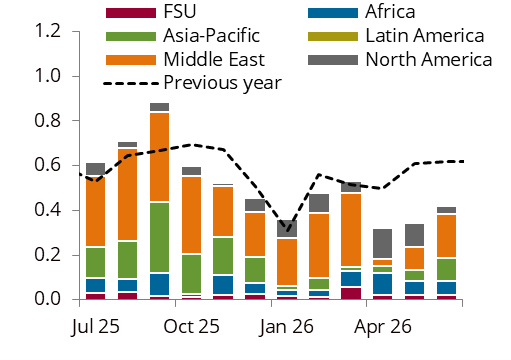
- 24 March 2026, 11:09: An EA Live alert made the call explicitly: “European jet imports to fall sharply from April as Middle East flows dry up.” We forecast imports at 0.17 mb/d in April, down 0.33 mb/d month-on-month and year-on-year, as Middle East flows effectively halted and tighter Asian balances capped exports from the region.
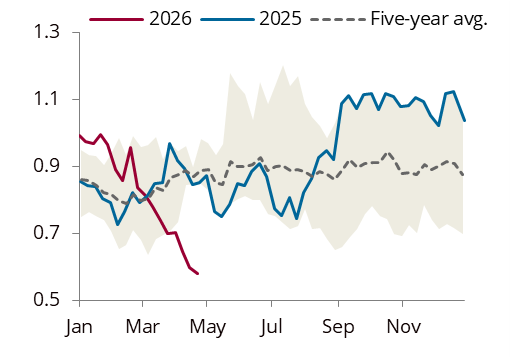
- Late March: A further EA Live post showed the tightening was already feeding through to storage. ARA jet fuel stocks drew by 56 kt week-on-week, sitting around 0.25 Mt lower year-on-year and below the five-year average, as east-of-Suez imports dried up.
European jet imports, mb/d

Source: OilX, Energy Aspects
ARA jet inventories, Mt

Source: Insights global, Energy Aspects
Why the call stood out
This was a specific market call based on near real-time flows analysis, regional balances and inventory monitoring.
Three signals mattered most:
Middle East jet fuel flows to Europe were drying up.
The prompt supply cushion was temporary.
Alternative barrels were limited.
That combination made jet fuel especially exposed and pointed to a tighter market, lower stocks and stronger prices.
What happened next
That tightening has become clearer through April.
European jet fuel imports have already fallen sharply this month, in line with our March call. ARA jet stocks have been drawing as east-of-Suez imports slowed, and replacement barrels remain limited. Prices have responded accordingly, with jet fuel continuing to outperform diesel and regrades staying elevated by historical standards.
Our latest view is that European jet fuel stocks could fall below the seasonal range by the end of May, keeping the market exceptionally tight through Q2 26 and supporting prices further.
Why this mattered for clients
For clients exposed to refined products, this was actionable intelligence. It highlighted early that jet fuel was likely to outperform diesel, that Europe’s import picture would deteriorate once in-transit cargoes cleared, and that price strength was likely to persist unless demand softened enough to rebalance the oil market.