Why oil benchmark prices don’t reflect the real cost of crude
April 23, 2026
The physical market is telling a very different story to the futures screen. Here is what is driving the disconnect — and why it matters for energy market participants.
The Strait of Hormuz crisis has produced one of the widest divergences between physical and paper crude oil prices in recent history. Benchmark futures suggest a market that is tight but manageable. The physical market tells a different story entirely.
Understanding why these two price signals have decoupled — and which one is more reliable — is critical for anyone making
trading, hedging, or investment decisions in the current environment.
What the oil benchmarks say versus what cargoes cost
At the time of writing, Brent crude futures are trading in the mid-$90s per barrel. That is elevated by recent historical standards, but it is not pricing a crisis. It does not signal the kind of acute supply disruption that the physical market is experiencing.
The physical market paints a starkly different picture. Dated Brent has surged well above $140/bbl. Dubai, the key Asian benchmark, spiked to $260/bbl ...
- Amrita Sen, Founder and Director of Market Intelligence
The physical market paints a starkly different picture. Dated Brent has surged well above $140/bbl. Dubai, the key Asian benchmark, spiked to $260/bbl before contract changes reduced the number of deliverable cargoes. West African and North Sea cargo prices are trading at substantial premiums to benchmarks. And once freight costs are factored in, crude is landing in Asia at approximately $170/bbl.
These are not marginal differences. The gap between the screen price and the actual cost of procuring and delivering a cargo of crude has widened to levels that are distorting refining economics, hedging strategies and procurement decisions across the globe.
Why oil futures are lagging the physical reality
As EA’s Quant team has been highlighting to clients, several structural factors are suppressing the paper price relative to the physical market.
Liquidity & Risk Capacity
Hedging Dislocation
Timing
The first is liquidity and risk capacity. Open interest and trading volumes have fallen sharply since the conflict escalated. Exchanges have raised margin requirements, and elevated realised volatility has sharply restricted VaR — the risk budget under which systematic and vol-sensitive funds operate — forcing them to cut positions regardless of fundamental view. The result is a thinner market, less responsive to fundamental signals, in which price discovery is being actively suppressed — not because participants disagree with the tightness thesis, but because they cannot carry the positions that would reflect it.
The second is the hedging dislocation. Many physical market participants had hedged Middle Eastern cargoes that never materialised. That has left them with short futures positions exposed against physical obligations that have shifted to higher-cost Atlantic basin supply. Unwinding those positions in a low-liquidity environment is difficult and slow.
The third factor is timing. The most acute tightness is concentrated in the prompt physical market — March and April loadings — while futures trade two months forward. That structural lag means futures are pricing a period when the market expects some recovery in Hormuz flows, even though the current physical shortfall is severe.
Asia is buying crude, but the West has not felt the full impact yet
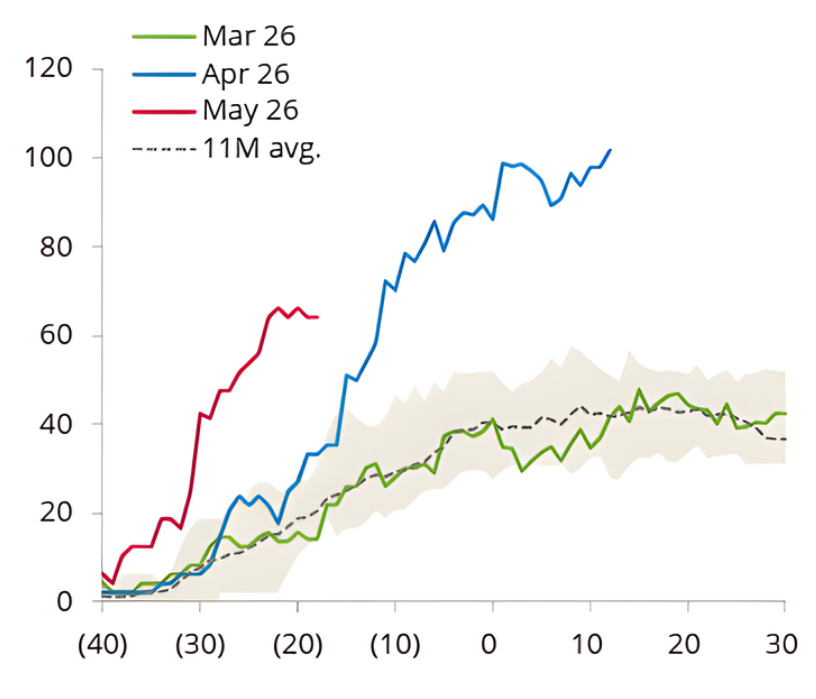
Asian buyers, facing the most direct exposure to the loss of Middle Eastern supply, have moved aggressively into the Atlantic basin. US crude exports have surged to record levels, running more than 1 mb/d above normal. That buying spree has pulled available supply away from European and US refiners, who typically purchase on shorter lead times.
The procurement cycle difference is significant. Asian buyers commit two months in advance. European buyers operate one month ahead. US refiners often purchase weeks or even days before delivery, relying on pipeline supply. In a scramble for barrels, Asia’s longer lead time has given it a structural advantage — and left Western buyers increasingly exposed to a tightening prompt market.
The implication is that the price impact in the West is delayed, not absent. As US refiners begin competing for a diminished pool of available crude in the May and June trade cycles, the physical price pressure that Asia has already absorbed will begin to materialise in Western benchmarks.

USGC implied fixtures to Asia, mb

Source: OilX, Energy Aspects
Refining margins are the transmission mechanism
The disconnect between physical crude prices and benchmark product prices pushed refining margins deeply negative in several regions. European margins weakened heavily month on month for the May planning cycle. Asian refiners are running for security of supply rather than margin, but even that approach has limits.
This is the mechanism through which the physical-paper gap eventually closes. Crude prices at current benchmark levels cannot sustain refinery operations when physical input costs are $40–50/bbl higher than the screen suggests. Either product prices must rise to restore margins, or crude benchmarks must fall to reflect the margin destruction — or, most likely, a combination of both, with products doing the next leg of the work.
Why convergence is coming — but not overnight
The physical and paper markets will converge. They always do. But the path and timing depend on several variables that remain uncertain: the pace of Hormuz transit recovery, the duration of Strategic Petroleum Reserve releases that are currently masking the tightness, and whether product prices rise fast enough to restore refining incentives before stocks reach critically low levels.
What is clear is that benchmark crude prices alone are an insufficient guide to the actual state of oil market fundamentals. Participants relying solely on the futures screen risk underestimating the severity of the current disruption — and the scale of the price adjustment that may still be ahead.
This analysis draws on Energy Aspects’ latest webinar ‘Hormuz transit – exploring the new normal for energy markets,’ recorded 16 April 2026, featuring Dr Amrita Sen (Founder and Director of Market Intelligence), Richard Bronze (Head of Geopolitics) and Livia Gallarati (Head of Global Gas).