

El Niño adds a new risk to Europe's gas storage

June 12, 2026


Europe's gas storage injection is running behind the five-year average, and a 96% probability El Niño event through July–September risks pulling LNG cargoes towards Asia at exactly the point Europe needs them most. Our analysis of the country-level exposure shows Germany carries the greatest risk.

Key Figures

Storage End April 35.5 bcm
El Niño Probability 96%

European gas storage ended April at 35.5 bcm, roughly 7 bcm higher than EA expected in late February, when the Hormuz conflict had barely begun to affect Middle Eastern LNG exports. On paper, that looked comfortable. The challenge is what came next.


Injection rates through May lagged the five-year average by 2.4 bcm, raising concerns that Europe may struggle to build sufficient inventory ahead of next winter.

Why El Niño introduces a material variable 


NOAA now puts the probability of an El Niño event at 96% for the July–September period. The direct implication for European gas markets is indirect but significant: a hotter-than-average summer in Asia would increase cooling demand and pull LNG cargoes away from European markets at a point when injections need to accelerate.


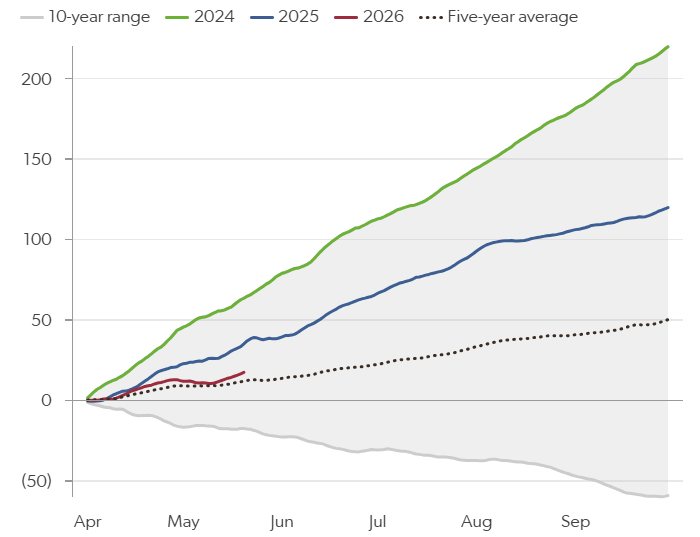
Our analysis of CDDs 5–10% above the 10-year norm suggests this scenario would reduce European LNG imports by 1.7–3.5 Mt in Q3. 

Cumulative Asia CDDs vs 10-year normal

Cumulative Asia CDDs vs 10-year normal

Source: Various government statistics, Spire, Energy Aspects

"Under a severe heatwave scenario using 2018 summer conditions as the baseline, TTF Q3 prices could be pushed to €52–63/MWh to incentivise coal-to-gas switching."

A separate but related risk is a hot European summer. High temperatures — particularly when accompanied by dry conditions constraining hydro and nuclear output — would require more gas in the power sector to balance the grid. Under a severe heatwave scenario using 2018 summer conditions as the baseline, TTF Q3 prices could be pushed to €52–63/MWh to incentivise coal-to-gas switching. This risk is distinct from the El Niño channel operating through Asia, though both would tighten European balances simultaneously.

How Hormuz fits into the storage picture

The storage restocking trajectory is already complicated by the ongoing disruption to Qatari LNG exports from the Strait of Hormuz. While some bilateral cargo movements have resumed, the pace of recovery remains below pre-conflict levels.


Our Geopolitical Research team notes that even an agreed MoU between the US and Iran would not immediately restore normal traffic; mine clearance and the establishment of tanker guidance through unmined lanes takes time, and disruptions could extend well into H2 2026.


The result is that European LNG receipts have fallen as Asian buyers have drawn Atlantic cargoes — primarily US and West African supply — away from European markets to compensate at least partially for lost Middle Eastern supply. Any El Niño-driven increase in Asian demand would tighten competition for precisely those Atlantic cargoes.

Why Germany's position differs from the rest of Europe

The risk is not distributed evenly across European markets. France and Italy operate under stricter mandatory fill requirements that provide structural support to their storage trajectories. Germany, as Europe's largest storage capacity holder, lacks equivalent regulatory protection: its injection economics depend more heavily on market price signals and participants in its less vertically integrated market have limited ability to pass higher costs down to downstream consumers, which limits the tolerance for backwardation.

Key Risk Factor

88

bcm

Critical storage buffer threshold for the German market.

"Under a summer in which TTF futures remain structurally inverted, German storage operators face a genuine economic disincentive to inject aggressively."

A comfortable storage buffer heading into winter sits around 88 bcm. Falling materially below this level raises the risk of price rises well above €50/MWh in a cold snap, because storage deliverability declines rapidly once inventories fall below 40% of capacity — meaning that even if supply eventually returns, a low starting point limits how quickly Europe can respond to peak demand.

What the forward market is and is not pricing

Market positioning suggests traders have been adding call spreads at €55–65/MWh concentrated over winter contracts. Our analysis suggests this structure understates the tail risk: if European inventories fall to historical lows on persistent supply disruption, prices could need to trade well above that range.


El Niño also carries a counter-balancing effect: quieter Atlantic hurricane seasons historically reduce LNG supply disruption risk through August–October, and the same weather pattern tends to produce milder winters in Japan, South Korea and India, freeing up more LNG for European regas. 

But that potential relief is not guaranteed, and cannot substitute for adequate storage built through the summer. The near-term injection risk is real regardless of what materialises in winter.


As LNG routing decisions crystallise through July, the margin between an adequate and a tight European storage carryout will narrow quickly.

Energy Aspects' Europe Gas service tracks weekly storage trajectories, LNG import flows and TTF forward curve dynamics across every EU market. 

Recent Posts

COI Update: Coverage, Storage Dynamics, & High Frequency Insights
June 9, 2026
Our team discussed the latest developments shaping global crude storage, including major coverage additions, evolving inventory patterns.
Emission
June 3, 2026
The EU-UK summit, reportedly in July could confirm ETS linkage, narrowing the EUA-UKA spread and reshaping European carbon markets for years to come.
Why the Strait of Hormuz won't reopen overnight
June 2, 2026
The market is treating Hormuz as binary: open or closed. EA's proprietary maritime data shows oil flow recovery will be slow, uneven and may never fully normalise.
Show More